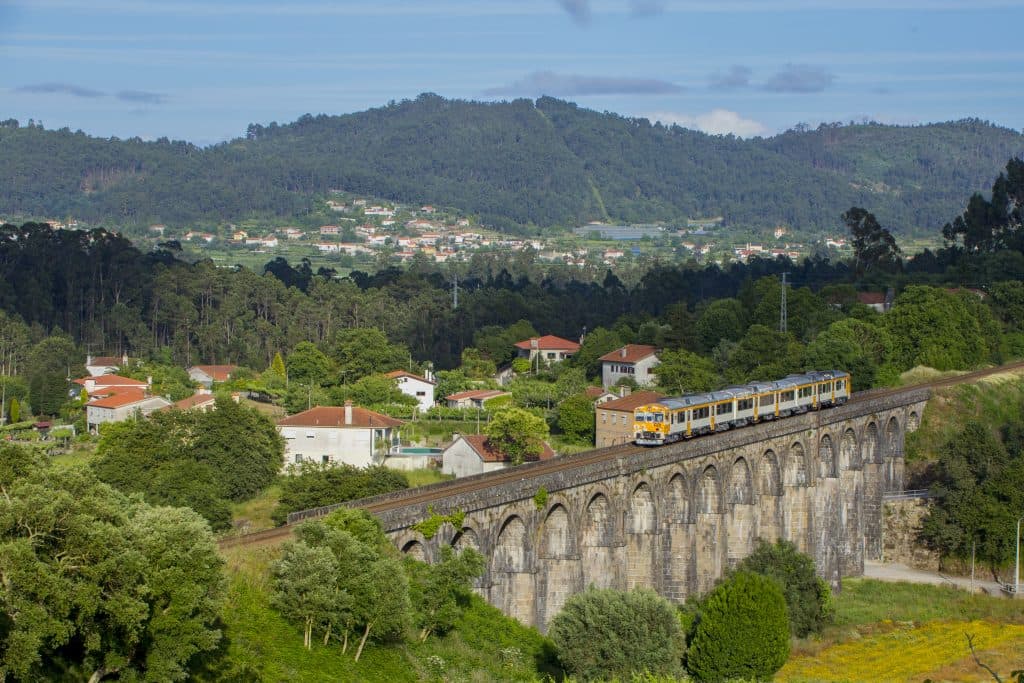
Pelos caminhos da Chã de Arefe
Difficulty
Distance
7.2 km
Duration
3h
Elevation gain
270 m
Altitude
64–307 m
Type
Loop
Description
Machine-translated from Portuguese.
The “Pelos caminhos da Chã de Arefe” trail is a short route, 7.2 km long, with a circular layout and a difficulty level of “somewhat difficult,” featuring several points of interest of an archaeological, rural, religious, and scenic nature, which runs through part of the territory of the Durrães and Tregosa Administrative Unit and also the Quintiães and Aguiar Administrative Unit. This trail invites hikers to embark on a journey through time, from prehistory to the present day. From the typical rural landscape of the Minho region to archaeological remains settlements dating from the Bronze Age to the Middle Ages, all the way to the iconic Ponte Seca, the route features various points of interest, in addition to the scenic beauty and, of course, the vast natural heritage typical of the Neiva Valley.
The starting and ending point of this
route is the old Durrães train stop, converted into the
“Porta do Neiva,” right in the center of the parish, from which the
route heads into the vast green and historic landscape of Monte de Arefe,
following rural and dirt paths
rural and dirt roads, all the way to the top of the Chã de Arefe plateau, with
the Neiva River, the smallholdings, Monte da Carmona, the
blue of the Atlantic Ocean, and Monte de Santa Luzia as a backdrop.
Notable points of interest include the Ponte Seca, built in the 19th century, and the archaeological remains scattered across Monte de Arefe, such as: the Castelos hillfort, the necropolis, the burial mounds, the intriguing hillfort trail, and the ancient settlement of Picoto dos Mouros. This, in addition to the hospitality of the locals and the vernacular architecture that stands out in the rural villages, combined with the tranquility typical of this area north of the municipality of Barcelos, results in an experience of great cultural, tourist, and natural value.
From a natural perspective, don’t be surprised if,
along the trail, you spot various species
such as the fox (Vulpes vulpes), the wild rabbit (Oryctolagus
cuniculus), the carrion crow (Corvus corone), the hoopoe (Upupa epops), the
magpie (Pica pica), the wren (Troglodytes troglodytes), the common blackbird
(Turdus merula), the common nightingale (Luscinia megarhynchos), and the cuckoo
(Cuculus canorus).
As for vegetation, the most common species are the stone pine (Pinus pinea L.), the
maritime pine (Pinus pinaster Aiton), the oak (Quercus faginea L.),
the cork oak (Quercus suber), the broom (Cytisus striatus), the eagle fern
(Pteridium aquilinum), and the heather (Calluna vulgaris), among others.
Respect nature, the people, and the places. Discover this route and be amazed by everything it has to offer.