Pelas margens do rio Angueira
Difficulty
Distance
22 km
Duration
6h
Altitude
633–769 m
Type
Loop
Description
Machine-translated from Portuguese.
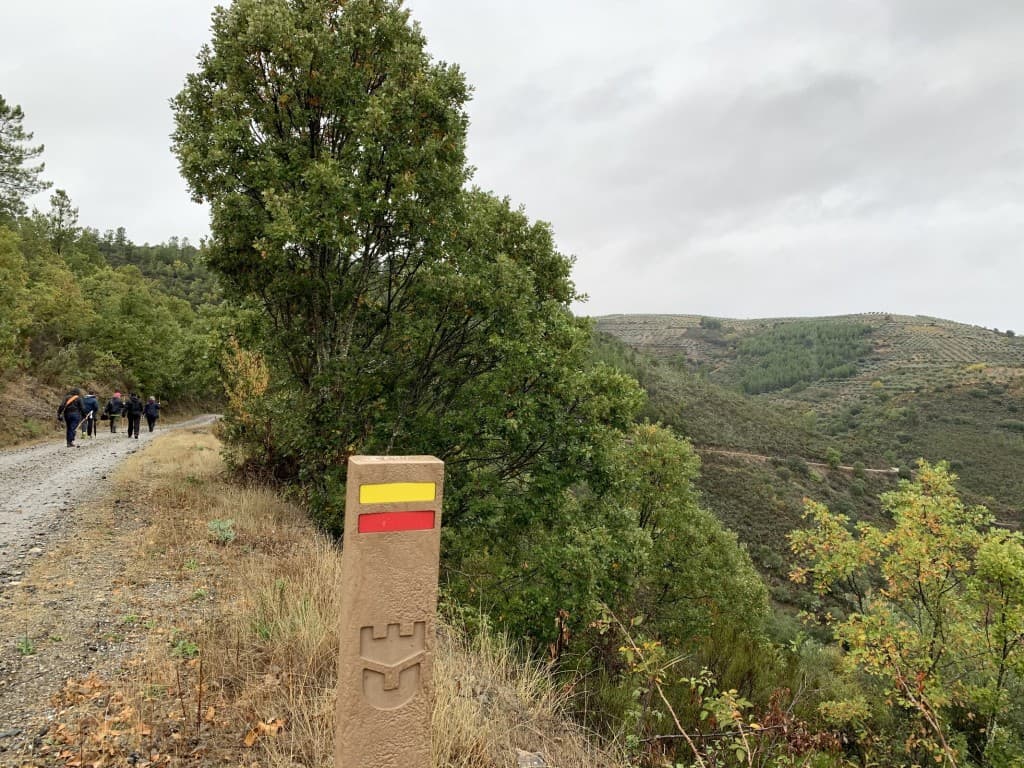
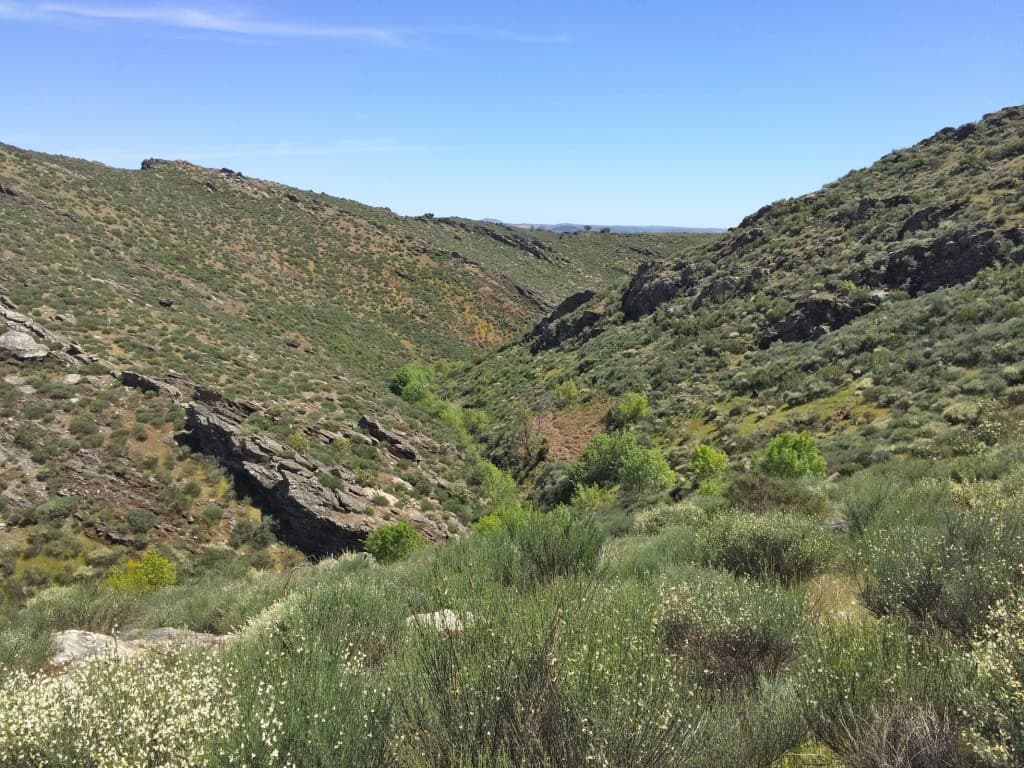
The route runs along the banks of the Angueira River, between the villages of S. Joanico, Serapicos, and Angueira.
Starting at the PINTA Exhibition Center (Iberian Nature,
Tourism, and Adventure), you’ll follow paths that pass over a
medieval bridge, by water mills, and across flagstone footbridges, winding through a lush
riverine gallery and a dense forest of oak and arbutus trees. You can
also visit PINTA’s Miranda Donkey Conservation Center,
where recreational and educational activities are held featuring animals of this
native breed.
Along this route, you may be surprised by a kingfisher in a
swift, blue flight, the spring flowers or wild roses bursting forth in the soft
soil of the oak grove, a roe deer grazing in a marsh, or a blanket of
buttercups covering a weir in white.
PINTA Exhibition Center
Begin this tour with a visit to the PINTA Exhibition Center,
whose central theme is the Natura 2000 network,
specifically the area that includes the municipality of Vimioso. As you explore the
exhibition, discover the biodiversity, culture, and traditions of a region
that is truly unique and has so much to offer. Right next door, you can also visit one
of the “Portas da Rota da Terra Fria”.
The Angueira River
As you walk along its banks, set out to discover everything that is
intimately connected to the river. The riparian forest, with willows, alders,
poplars, and ash trees, covers the riverbed and makes your
walk more refreshing. The riparian and aquatic fauna—the river kingfisher, the sand martin,
the otter, the kingfisher, the dragonflies, and the barbel. Ancient evidence of
human presence—the medieval bridge of S. Joanico, the weirs, the canals, and
the mills for grinding grain, the footbridges for crossing the river, and the
waterwheels for drawing water from the river.
The Marshes
These traditional pastures, flanked by ash trees and/or walls made of
stone blocks, constitute one of the most typical landscapes of Northeast
Trás-os-Montes, particularly in the northern part of the municipality of Vimioso. In the
marshes, Mirandese cows, Churra sheep, and Mirandese donkeys graze,
guarded by sheepdogs and Transmontano cattle dogs. Fresh grass
grows during the spring, is mowed in the summer, and stored as
hay after it dries, to feed the livestock in the winter. The branches of the
ash trees are cut each year; the leaves serve as food for the
livestock, and the wood is used for burning in the fireplace during the winter. It is in
landscapes like this that you can spot the Iberian wolf, the roe deer, the
blue tit, and the lesser spotted woodpecker, and hear the tawny owl at
dusk. These marshes boast a specific and
unique floral diversity, including some species of wild orchids of the genus Orchis
spp., among others.
The Woodland
Between the villages of Angueira and Serapicos, on the left bank of the
Angueira River, you’ll walk along the edge of an extensive and well-preserved
native woodland, which is home to a considerable diversity of species, with
notably the Pyrenean oak (Quercus pyrenaica) and the strawberry tree
(Arbutus unedo). In its understory, species such as the
wolf’s-bane or broter’s peony (Paeonia broteri) and the poplar rockrose (Cistus
populifolius) thrive. In terms of fauna, the roe deer (Capreolus
capreolus) stands out, along with some passerines such as the jay, the blue nuthatch, the
common nuthatch, the goldcrest, and the flycatcher.
Local communities have always used these woodlands to gather and
utilize certain byproducts, such as wood, which was used
to make utensils and for heating in the winter, and
mushrooms, both for personal consumption and for sale.
Nearby trails
- Distance
- 13 km
- Duration
- 4h30