Entre o Alva e a Ribeira da Mata
Difficulty
Distance
12 km
Duration
1h45
Elevation gain
420 m
Altitude
175–282 m
Type
Loop
Description
Machine-translated from Portuguese.
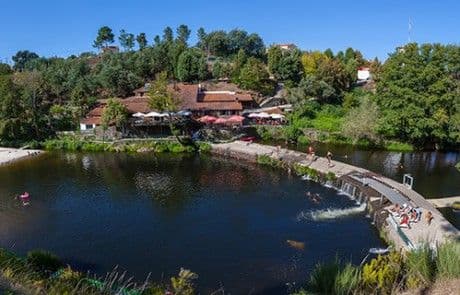
The PR5 AGN trail connects Coja to the village of Barril de Alva along the valley of the Alva River, via forest trails, offering a rural landscape rich in flora and geology, as well as some interesting examples of historic architecture. It is also possible to walk across the alluvial plain of Ribeira da Mata to the village of Pisão via the PR5.1 AGN detour. You can also choose to hike along the PR5.2 AGN to the Alva River reservoir in the Urtigal recreation area.
The Towns
Coja
The first sight that catches the eye of anyone visiting Coja is the Alva River and
the majestic bridge connecting both banks. The Manueline pillory,
which stands in Praça Dr. Alberto Valle, bears witness to the importance
Coja held in the past, as well as its rich architectural heritage,
where 17th- and 18th-century houses and religious buildings bear witness to
a past steeped in history.
The nickname “Princess of the Alva,” by which it is known, stems from the
importance of the Alva River as a fundamental element in its
development over time, together with the Ribeira da Mata
which flows into the “heart” of the town, where the two Romanesque-style
bridges create an impeccable setting. All this harmony, combined
with the natural beauty of the weirs and river beaches, results in
tourism potential that makes Coja a destination of choice.
Barril de Alva
There are no known records prior to 1527, the year in which the
Census of the Kingdom’s Population, conducted at the behest of King João III, noted that
Barril belonged to the municipality of Coja and had 10 households. However, it is quite
possible that the settlement grew out of the site of Casal
Fundeiro, where the Quinta de Santo António estate was located, owned by the “family of the
Freires, owners and lords of many lands all the way to the river…,” with a coat of arms
dating from the 17th century. Near this village, on the right bank of the
Alva River, after crossing a granite bridge built in 1880, we can
find the picnic area with a barbecue and wood-fired oven, where
there is a barrel-shaped fountain made of granite, which has become a
distinctive landmark of the village of Barril de Alva. In the summer, you can also
enjoy the recreational area at the bridge, where a
wooden dam has been built to power the waterwheel that was once used to
irrigate the fields along the banks of the Alva. You can also enjoy the
Urtigal Recreation Area, where, in terms of the landscape,
the weir stands out, creating a vast expanse of water; it is a beach
featuring attractive recreational areas, clear water, and
light-colored sand. The surrounding area is characterized by an extensive wooded zone
offering a prime spot for relaxation.
Pisão
This picturesque town is known for its streets adorned with
flowers, the various fountains that give it a unique character, and the
stately homes, among which the family home of D. José
Alves Mattoso stands out.
Cuisine
Well known for its delicacies, it embraces traditions with unique knowledge and
flavors, inspired by the ancient monasteries and stately homes.
Some of the main delicacies you can enjoy include chanfana,
pork cracklings, roast kid, tripe, as well as various sweets, among which
the tigelada, jams, liqueurs, rice pudding, and potato bread
. These products can be sampled and purchased at the various
restaurants and local shops.
Flora and Fauna
This area of the Alva Valley is located near the
Serra do Açor Protected Landscape (PPSA), and along the
riverbanks, it is possible to find some of the species
of flora and fauna characteristic of this area. Notable species include the Portuguese cherry (Prunus lusitanica subsp. lusitanica), the holly (Ilex aquifolium), and the bay laurel (Laurus nobilis). Still on the subject of flora, it is important to highlight the presence of several endemic and/or rare plant species, such as Narcissus sp.. Other species characteristic of Portuguese flora, commonly observed along the route, include maritime pine (Pinus pinaster), cork oak (Quercus suber), Pyrenean oak (Quercus pyrenaica),-alvarinho (Quercus robur), sweet chestnut (Castanea sativa), heather (Erica sp.), broom (Cytisus sp.), gorse (Ulex sp.), strawberry tree (Arbutus unedo), hawthorn (Crataegus monogyna), broom (Chamaespartium tridentatum), or blackberry (Rubus ulmifolius).
The biotopes found in the area support a diverse fauna and the presence of some Iberian endemic species. Among the habitats most relevant to the fauna are the deciduous forests, riparian galleries, scrublands, and agricultural and olive grove areas. The inventory conducted in the PPSA identified 423 species of invertebrates and 117 species of vertebrates. Notable examples include the Lusitanian salamander (Chioglossa lusitanica), listed as Vulnerable in the Red Book of Vertebrates of Portugal, and an Iberian endemic; among the bird species, the saker falcon (Circus pygargus), the goshawk (Accipiter gentilis), and the barn owl (Asio flammeus). Among mammals, the wild boar (Sus scrofa), the European hedgehog (Erinaceus europeus), and the weasel (Mustela nivalis) are very common. Several of these species are listed in the Red Book of Vertebrates of Portugal (Source: ICNF, 2013).
Nearby trails
Caminho do Xisto de Vila Cova de Alva
Arganil, Coimbra
- Distance
- 8.5 km
- Duration
- 2h
- Elevation gain
- 424 m