Rota das Aldeias
Difficulty
Distance
13 km
Duration
4h
Type
Loop
Description
Machine-translated from Portuguese.
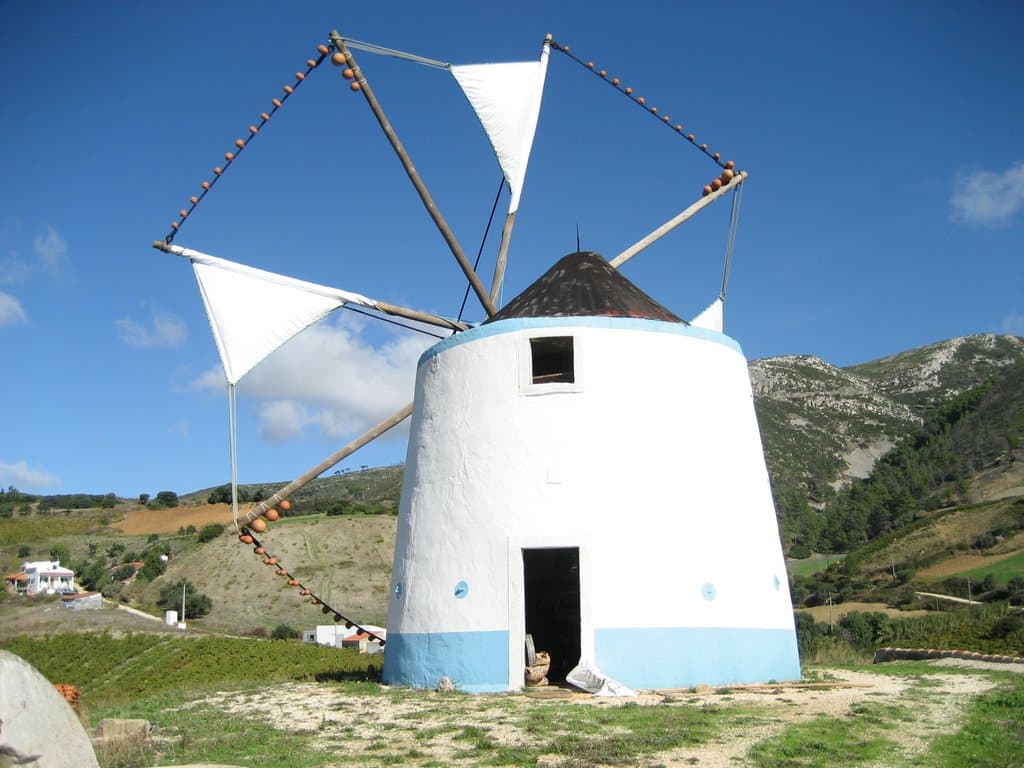
The trail begins at Malveira da Serra, located on the slopes of the Serra de Sintra. It passes through shady planted forests, groves of native vegetation, areas primarily occupied by invasive species, Mediterranean- or Atlantic/Mediterranean-style scrub, and meadows. At Peninha, the landscape is magnificent: Cabo Raso and the Guincho–Oitavos dune chain, extending inland and to the southeast, reveal the direction of the prevailing winds. To the southwest, near the sea, lie the villages of Biscaia and Figueira do Guincho, with remnants of old lime kilns, quarries, and even fortresses that strategically defended the coast. This entire region and its population are eminently rural, people of the countryside devoted to farming, herding, and, until quite recently, grinding grain in watermills and windmills, as well as operating bread and lime kilns, from which they obtained the food for their sustenance and the raw materials to build their homes. One of the lime kilns, known as Gaiteiro, was located in the area of Almoínhas Velhas. This entire Saloia community possesses unique characteristics in its customs, language, beliefs, clothing, and even its way of working.Saloio: a word derived from the Arabic Çahruii, meaning “country dweller” or “peasant” in the Lisbon region at the time of its conquest by Afonso Henriques.Along this route, one can find some of the species from the original vegetation cover: the pedunculate oak (Quercus robur), the sessile oak (Quercus faginea), the Pyrenean oak (Quercus pyrenaica), kermes oaks (Quercus coccifera), cork oaks (Quercus suber), wild olive trees (Olea europaea var. sylvestris), the rare holly (Ilex aquifolium), bay laurel (Laurus nobilis), and strawberry tree (Arbutus unedo). Whenever shade or moisture conditions permit, butcher’s broom (Ruscus aculeatus), English ivy (Hedera helix), foxglove (Digitalis purpurea), or laurel-leaved daphne (Daphne laureola) associated with the cypress grove. In the scrublands, gorse (Ulex sp.), giant feather grass (Stipa gigantea), sea aster (Urginea maritima), rough sarsaparilla (Smilax aspera), rockroses (Cistus sp.), violets (Viola odorata), perennial pimpernel (Anagalis monelli), male spurge (Euphorbia characias), heather (Calluna vulgaris), and rosemary (Rosmarinus officinalis).Despite the beauty and magic of the surroundings, one of the park’s most serious ecological problems is all too evident: the struggle of the natural vegetation to survive. After the great fire of 1966, conditions arose that allowed invasive species such as Hakea (Hakea sericea), pittosporum (Pittosporum undullatum), and especially acacias (Acacia melanoxylon and A. longifolia) to rapidly occupy available habitats and expand on a large scale in a way that remains uncontrollable to this day. In general, wildlife is difficult to spot, but the hike is rarely completed without at least one of the most common birds of prey in these parts—the round-winged eagle or the common buzzard—surprising hikers with its characteristic flight.